
Modular IVF laboratory
Modular IVF laboratories built for a genuinely sensitive environment
Embryology areas react to volatile organic compounds as much as to particulates. Material selection, zoning, monitoring and commissioning practice matter as much as filter selection.
Design intent
Zoning first, finishes second
An IVF laboratory is planned around the movement of gametes and embryos, and around the equipment that sustains them.
Layout separates patient-facing areas from andrology, embryology and cryostorage, with controlled transfer at every boundary. Where the clinical model allows it, the retrieval room connects directly to embryology through a pass-through so transport time and exposure are minimised.
Materials are selected for low emission as well as cleanability, and the programme allows time for bake-out and flush-through before validation — compressing the final weeks of an IVF laboratory project is a false economy.
Equipment positions are fixed before benching is fabricated. Incubator banks, workstations and cryo vessels each impose heat, gas, power, vibration and access requirements that cannot be resolved after installation.
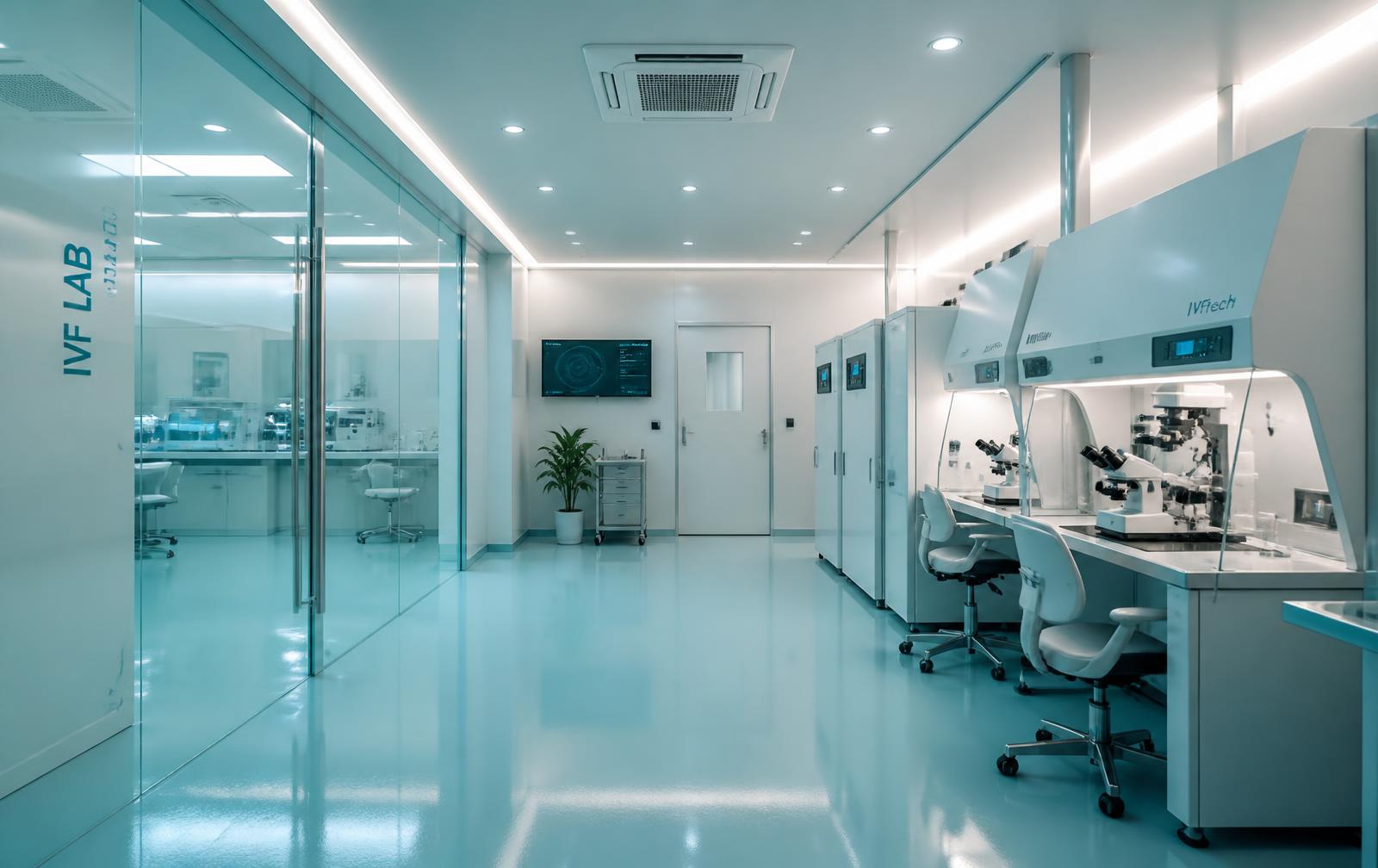
Laboratory zones
How the laboratory is organised
- Reception & consultation
- Patient-facing areas kept fully separate from the laboratory environment.
- Retrieval / procedure room
- Directly linked to embryology through a hatch or pass-through to minimise transport time.
- Andrology
- Sample processing area with its own workstation, extraction and separation from embryology.
- Embryology
- The most tightly controlled zone: incubator bank, workstations and micromanipulation positions.
- Cryostorage
- Cryo vessel area with ventilation, oxygen-depletion monitoring and level alarms.
- Support & storage
- Media and consumable storage, gowning, waste route and services access.
Scope of work
What an IVF laboratory package covers
- Laboratory planning
- Zoning of reception, consultation, OT/retrieval, andrology, embryology, cryostorage and storage areas with controlled transfer between them.
- Workflow separation
- Movement paths for patients, staff, samples and materials arranged so that sensitive embryology areas are reached only through controlled transitions.
- Air quality & contamination control
- Multi-stage filtration with terminal HEPA, and where specified VOC filtration, using low-emission materials, adhesives and flooring systems.
- Pressure cascade
- Positive pressure relationships between embryology, adjacent zones and corridors, with differential pressure indication where required.
- Equipment positioning
- Incubator banks, laminar flow workstations, microscopes, micromanipulators and cryo vessels located against their heat, gas, vibration and access needs.
- Electrical & backup power
- Dedicated circuits for incubators and cryo monitoring, UPS coverage, DG changeover and alarm-linked power monitoring.
- HVAC & environmental control
- Temperature and humidity stability, air-change rates suited to occupancy and equipment heat load, and quiet operation in working areas.
- Gas supply
- CO2 and N2 supply arrangements to incubators and workstations, with changeover, alarms and leak-detection provisions.
- Monitoring & alarms
- Continuous monitoring of temperature, CO2, pressure and cryo tank levels with local and remote alerting.
- Validation & commissioning
- Bake-out and flush-through, particulate counts, airflow and pressure verification, monitoring calibration and documented handover.
- Maintenance
- Filter replacement schedules, monitoring calibration intervals, gas equipment service and support arrangements.
IVF laboratory enquiry
Plan an IVF laboratory
Share the available area or floor plan, expected cycle volume, equipment already selected and your target commissioning date.
Project consultation
Planning a new facility, a department upgrade or an equipment purchase?
Share your requirement and our engineering team will respond with clarifying questions, a suggested scope and — where a site visit is needed — a proposed visit date.